Leave A Message
If you are interested in our products and want to know more details,please leave a message here,we will reply you as soon as we can.
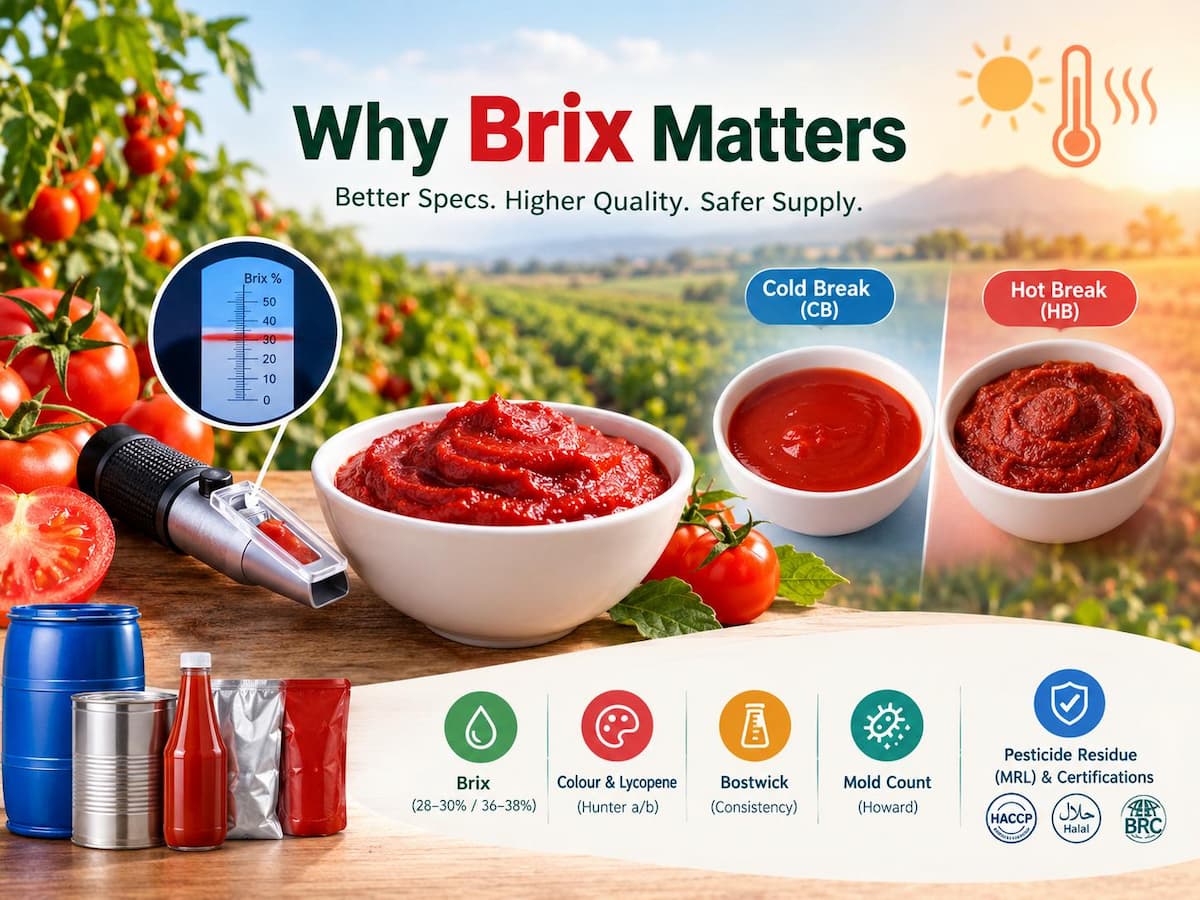
Every tomato paste buyer eventually learns the same lesson: price per tonne means nothing until you know the Brix. Brix is the percentage of soluble solids — mostly sugars, with a smaller share of organic acids and minerals — measured with a refractometer at the plant gate. It is the single most important number on a tomato paste specification sheet, because it determines how much actual tomato you are paying for after the water is evaporated out.
A typical processing tomato leaves the field at roughly 4.5 to 5.5 Brix in Mediterranean growing regions. To reach the double concentrated tomato paste most industrial buyers purchase, that fruit must be concentrated to 28-30% Brix — roughly six times the solids of the raw fruit. Reach 36-38% Brix and you are talking triple concentrate, used mainly in high-value sauces and certain HoReCa applications.
Here is why Brix is so sensitive to weather: the same tonne of fruit that tests 5.2 Brix in a normal year might test 4.8 in a heatwave year. If the factory must hit a fixed 28-30 Brix output, lower incoming Brix means more evaporation time, more energy, more labour per finished tonne — and a paste that can drift in colour and viscosity if the process is rushed. That cost and quality risk travels down the chain to whoever signs the contract.
The 2026 season is a live case study in why buyers should not rely on last year's numbers. The World Processing Tomato Council (WPTC) crop update of 28 August 2026 points to a global processing estimate of 39.8 million tonnes, about 1.5% below the 40.3 million tonnes processed in 2025 — with the gap concentrated in heat-stressed regions.
Across Southern and Western Europe, continuous heatwaves, sunburn, and localised rainstorms have simultaneously impaired yields and Brix levels. France has trimmed its season forecast to roughly 145,000-150,000 tonnes, with blossom end-rot, sunburnt fruit, and floral abortion reducing late-season yields. Spain and Türkiye carry similar downward revisions, while California is progressing well and expected to come in slightly above the May USDA forecast.
Three specific field signals deserve a buyer's attention:
What this means for a buyer is concrete: the marginal tonnage that normally smooths out price and quality volatility is thinner this year. Sourcing purely on headline price, without pinning down the Brix and colour of the specific lot you are being quoted, is riskier in 2026 than in a normal season.
Brix tells you how concentrated the paste is; the break temperature tells you how it will behave once it is in your product. This is the most common specification question we field from importers, and it is one that a heatwave year makes more consequential.
In a heatwave year, the incoming fruit often carries lower natural viscosity and colour. A hot-break paste can help compensate for that loss of body, which is why some buyers shift their specification toward hot break when they see 2026-style field conditions. The decision should be explicit in the contract — not left as a default at the factory.
Brix is the headline, but a defensible 2026 contract pins down five things:
One practical move many buyers take in volatile years: request a current-lot sample and a dated spec sheet before committing, and tie the contract to a pre-shipment inspection (SGS or equivalent) so the numbers you approve are the numbers that ship.
What Brix should I specify for bulk tomato paste?
Most industrial buyers specify 28-30% Brix for double-concentrated paste and 36-38% Brix for triple concentrate. A reliable supplier should be able to offer the full 18-30% Brix range across cold-break and hot-break processes so you can match the spec to your finished product rather than accepting whatever is in stock.
What is the difference between hot break and cold break, and which should I order?
Hot break is heated to 85-100°C to deactivate pectin enzymes, producing a thicker, higher-viscosity paste — the standard for ketchup and pizza sauce. Cold break is held around 60-65°C, giving a thinner, brighter, more tomato-fresh paste. In a heatwave year with lower natural viscosity, many buyers lean hot break to recover body.
How do I verify Brix and quality before I sign?
Request a current-lot sample together with a dated specification sheet showing Brix, Hunter colour, Bostwick consistency, and mold count, and arrange a pre-shipment inspection. A supplier that runs HACCP, Halal, and BRC-certified lines and offers free samples makes this verification straightforward.
Does the 2026 heatwave affect pricing and availability?
Yes. With WPTC estimating global processing at about 39.8 million tonnes — 1.5% below 2025 — and specific shortfalls in Bulgaria, Egypt, and France, marginal supply is thinner. Locking a fixed Brix spec and delivery schedule early protects you from chasing lower-Brix replacement lots later in the season.
What is the typical MOQ and packaging for tomato paste?
MOQ varies by packaging. Common formats include sachets (flat or stand-up pouches), tins, aseptic bags-in-drums, squeeze bottles, and foodservice bulk packs — with OEM/ODM private-label runs available. Ask for the full format list and the MOQ per format before you compare unit prices.
How long does tomato paste keep, and what certificates do I need?
Shelf life depends on packaging and storage — aseptic bag-in-drum packs for industrial use keep substantially longer than opened retail formats. Confirm the stated shelf life on the spec sheet, and match certificates (HACCP, Halal, BRC, FDA registration) to your destination market's import requirements.
Where can I find a dependable tomato paste supplier with verifiable specs?
If you want a single source that can document Brix, break type, colour, and certifications for the current 2026 season — and ship samples before you commit — the export desk below handles the full 18-30% Brix range across cold- and hot-break processes. You can find our details in the card that follows.


 English
 Français
 Deutsch
 Italiano
 Pусский
 Español
 Português
 Melayu
 Indonesia
 العربية