Leave A Message
If you are interested in our products and want to know more details,please leave a message here,we will reply you as soon as we can.
For food importers, distributors, wholesalers, and emerging food brands, launching a private label tomato paste product can be an effective way to build brand recognition and expand market opportunities. However, before choosing a manufacturing partner, one important decision needs to be made: should you choose OEM or ODM tomato paste?
Both OEM (Original Equipment Manufacturing) and ODM (Original Design Manufacturing) allow businesses to sell tomato paste under their own brand names. The main difference lies in product development, formulation control, packaging customization, and the level of involvement required from the buyer.
Understanding these differences can help you select the right private label model, manage costs, and establish a more efficient supply chain.
OEM tomato paste manufacturing means that the buyer provides the product specifications, formulation requirements, or detailed production instructions, while the manufacturer produces the tomato paste according to those requirements.
Under an OEM arrangement, the buyer generally has greater control over the final product. Specifications may include Brix levels, color, consistency, ingredient requirements, packaging materials, package sizes, and labeling designs.
For example, a food importer may require 28–30% Brix hot break tomato paste in customized pouches or bulk drums. The manufacturer follows the agreed specifications and production standards to deliver products that meet the buyer's requirements.
OEM tomato paste is particularly suitable for:
Established food brands with existing product formulas.
Importers who have clear product specifications.
Distributors looking to expand their private label product lines.
Buyers who require specific Brix levels, packaging formats, or ingredient standards.
Key advantage: OEM provides greater control over product specifications and brand presentation, making it suitable for businesses with established product requirements.
ODM tomato paste manufacturing means that the manufacturer provides existing product solutions or develops products based on the buyer's market requirements. The buyer can then select suitable products and customize branding and packaging.
Compared with OEM, ODM generally requires less product development work from the buyer. It is a practical option for businesses that want to enter the tomato paste market without developing a complete product specification from the beginning.
For example, a new food distributor may want to launch a private label tomato paste brand in West Africa. Instead of developing a formulation independently, the buyer can discuss suitable tomato paste concentrations, packaging sizes, taste preferences, and market positioning with an experienced manufacturer.
The manufacturer can recommend suitable product options and packaging solutions based on the target market.
ODM tomato paste is particularly suitable for:
Start-up food brands entering the tomato paste market.
Importers without an established product formulation.
Wholesalers looking for ready-made private label solutions.
Buyers who want to simplify product development and shorten preparation time.
Key advantage: ODM reduces the buyer's product development workload by allowing them to work with existing manufacturing expertise and product solutions.
Although both models support private label manufacturing, they differ in how product specifications are developed and who takes the lead in product design.
| Comparison | OEM Tomato Paste | ODM Tomato Paste |
|---|---|---|
| Product development | Buyer-led specifications | Manufacturer-led solutions |
| Formulation | Based on buyer requirements | Based on available or developed solutions |
| Brix selection | Customized according to requirements | Selected from suitable product options |
| Packaging | Customized according to buyer specifications | Existing or customized packaging solutions |
| Brand ownership | Buyer's brand | Buyer's brand |
| Development involvement | Higher buyer involvement | Lower buyer involvement |
| Ideal customers | Established brands and experienced importers | Start-ups and new market entrants |
One important point is that OEM and ODM are not completely separate packaging options. Both models can support customized labels, package sizes, and branding, depending on the manufacturer's capabilities and the agreed order requirements.
The most suitable model depends on how much control you want over product development and how much support you need from your manufacturing partner.
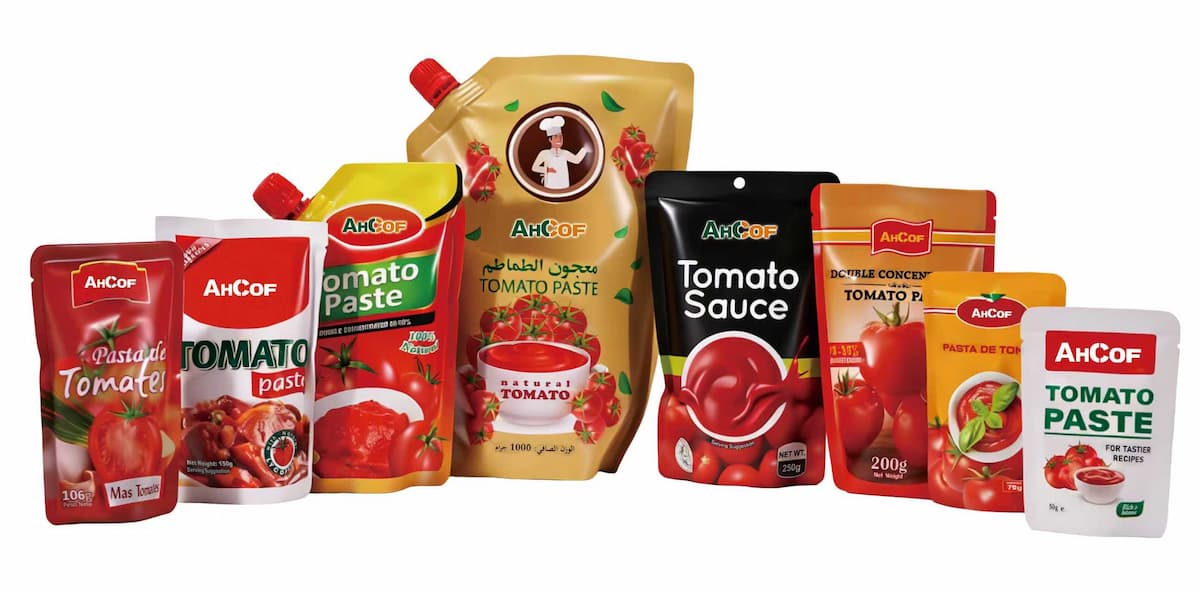
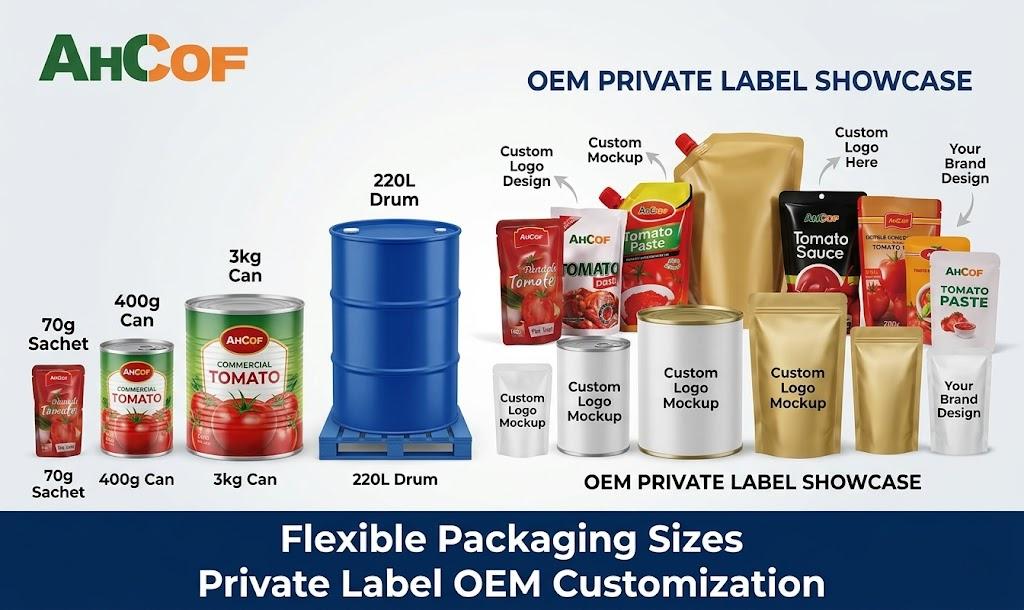
Packaging is an important part of private label tomato paste manufacturing because different markets have different retail habits, distribution channels, and consumption requirements.
A reliable OEM/ODM tomato paste manufacturer should be able to offer multiple packaging solutions rather than limiting buyers to one standard format.
Common private label tomato paste packaging options include:
Tomato Paste Sachets and Pouches
Small sachets, such as 50g and 70g packs, are suitable for household consumption, small retailers, and markets where affordable single-use portions are popular. Larger pouches can serve supermarkets, catering businesses, and foodservice distributors.
Tinplate cans are available in different sizes for retail and commercial applications. They are suitable for buyers who prefer traditional canned packaging and require convenient storage and distribution.
Tomato Paste in Plastic Bottles and Jugs
Plastic bottles and jugs offer convenient dispensing and storage. They can be considered for tomato sauce and ketchup products as well as suitable tomato-based products, depending on viscosity and packaging compatibility.
Large aseptic drums are designed for industrial buyers, food processors, and manufacturers that use tomato paste as a raw material in further production.
When selecting packaging, buyers should consider product viscosity, filling compatibility, transportation conditions, shelf-life requirements, target consumers, and local regulations.
Choosing between OEM and ODM requires more than comparing manufacturing costs. Your business stage, target market, product positioning, and purchasing experience should all be considered.
Choose OEM if:
You already have a defined tomato paste formulation or technical specification.
Your brand requires specific Brix levels, color, consistency, or ingredient requirements.
You have established packaging designs and labeling standards.
You need consistent product specifications across multiple orders.
Choose ODM if:
You are launching a new private label tomato paste brand.
You are unfamiliar with tomato paste manufacturing specifications.
You need recommendations for product concentrations and packaging sizes.
You prefer a manufacturer to help develop a suitable product solution.
For businesses that are still exploring the market, ODM can be a practical starting point. As your brand grows and your product requirements become more specific, you can consider moving toward a more customized OEM arrangement.
Some manufacturers also offer flexible cooperation that combines ODM product recommendations with OEM packaging and branding customization.
Selecting the right manufacturing partner is just as important as selecting the right private label model. Before placing an order, international buyers should evaluate several key factors.
1. Manufacturing Experience
Check whether the supplier has experience producing tomato paste for international markets and handling different packaging formats.
2. Product Specifications
Confirm available Brix levels, hot break or cold break processing options, color, consistency, and ingredient requirements.
3. Packaging Capabilities
Ask whether the manufacturer supports sachets, pouches, tinplate cans, plastic bottles, plastic jugs, and bulk packaging.
4. Quality Control and Certifications
Review the manufacturer's food safety management systems, quality inspection procedures, and relevant certifications. Requirements may vary depending on the destination market.
5. OEM/ODM Customization Services
Confirm whether the manufacturer can support private label design, customized packaging, product specifications, and labeling requirements.
6. MOQ and Production Lead Time
Ask about minimum order quantities for different packaging formats, printing requirements, sample arrangements, and production schedules.
7. Export and Logistics Experience
An experienced export manufacturer should understand international shipping arrangements, export documentation, packaging requirements, and destination-market compliance.
A thorough evaluation helps reduce sourcing risks and establishes a more reliable long-term manufacturing relationship.
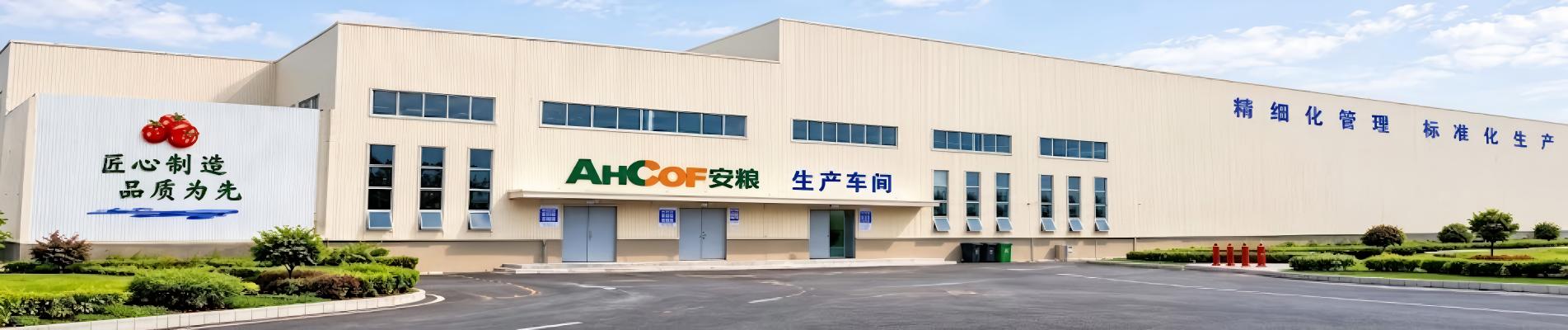
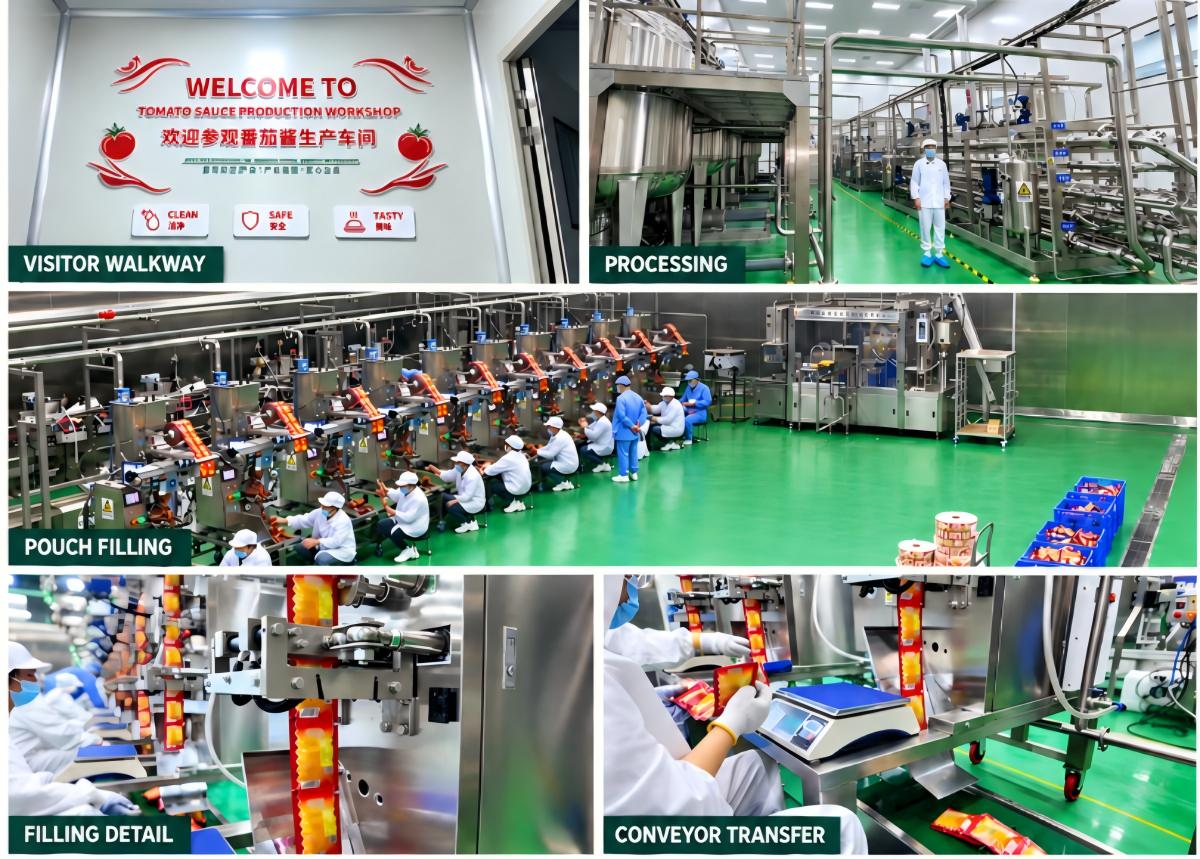
AHCOF provides tomato paste manufacturing and export solutions for international importers, distributors, wholesalers, and food brands seeking reliable private label products.
With manufacturing facilities in China and experience serving international markets, AHCOF supports different cooperation requirements, from standardized tomato paste supply to customized OEM and ODM projects.
Available product and packaging solutions include:
Tomato paste in sachets and pouches.
Tomato paste in tinplate cans.
Tomato-based products in plastic bottles and jugs.
Bulk tomato paste for industrial applications.
Customized product specifications and private label packaging.
Whether you already have a complete product specification or need professional assistance in developing a private label tomato paste product, AHCOF can discuss suitable manufacturing and packaging solutions based on your business requirements.
For buyers targeting Africa, the Middle East, Southeast Asia, and other international markets, selecting the right product concentration, packaging format, and brand presentation is essential for building a competitive product line.
Looking for an OEM or ODM tomato paste manufacturer in China? Contact AHCOF to discuss your product specifications, packaging requirements, and private label project.
Q1: What is the difference between OEM and ODM tomato paste?
OEM tomato paste is manufactured according to the buyer's product specifications, while ODM tomato paste uses the manufacturer's existing product solutions or product development expertise. Both models allow buyers to sell products under their own brands.
Q2: Can I use my own brand name for OEM and ODM tomato paste?
Yes. Both OEM and ODM arrangements can support private label branding. Buyers can discuss customized labels, packaging designs, and brand presentation with the manufacturer.
Q3: Is OEM or ODM better for a new tomato paste brand?
ODM is often a practical choice for new brands because the manufacturer can recommend suitable product specifications and packaging solutions. OEM is more suitable when the buyer already has defined product requirements.
Q4: What packaging options are available for private label tomato paste?
Common options include sachets, pouches, tinplate cans, plastic bottles, plastic jugs, and bulk aseptic drums. Availability depends on the manufacturer's production capabilities and the product requirements.
Q5: Can I customize the Brix level of private label tomato paste?
Yes, depending on the manufacturer's production capabilities. Buyers can discuss different Brix requirements, such as 28–30% and 36–38%, as well as hot break or cold break processing options.
Q6: What information should I provide when requesting an OEM or ODM tomato paste quotation?
Buyers should provide the target market, preferred Brix level, product type, packaging format, package size, estimated order quantity, and any specific labeling or certification requirements. These details help the manufacturer evaluate the project and prepare a more accurate quotation.
Q7: Can I request samples before placing a bulk order?
Sample arrangements can be discussed with the manufacturer before order confirmation. Buyers should evaluate product quality, color, consistency, taste, and packaging suitability before proceeding with large-volume purchases.


 English
 Français
 Deutsch
 Italiano
 Pусский
 Español
 Português
 Melayu
 Indonesia
 العربية