Leave A Message
If you are interested in our products and want to know more details,please leave a message here,we will reply you as soon as we can.
When sourcing tomato paste for food manufacturing, wholesale distribution, or private-label production, understanding product specifications is essential. Two tomato paste products may have similar prices but perform differently in terms of concentration, color, texture, and flavor. These differences can affect production efficiency, finished product quality, and overall purchasing costs.
For importers and food manufacturers, four key specifications deserve particular attention: Brix, color, consistency, and acidity. Each provides different information about the product, and evaluating them together helps buyers select tomato paste that meets their application requirements.
This guide explains what these specifications mean, how they are measured, and what buyers should consider when comparing tomato paste suppliers.
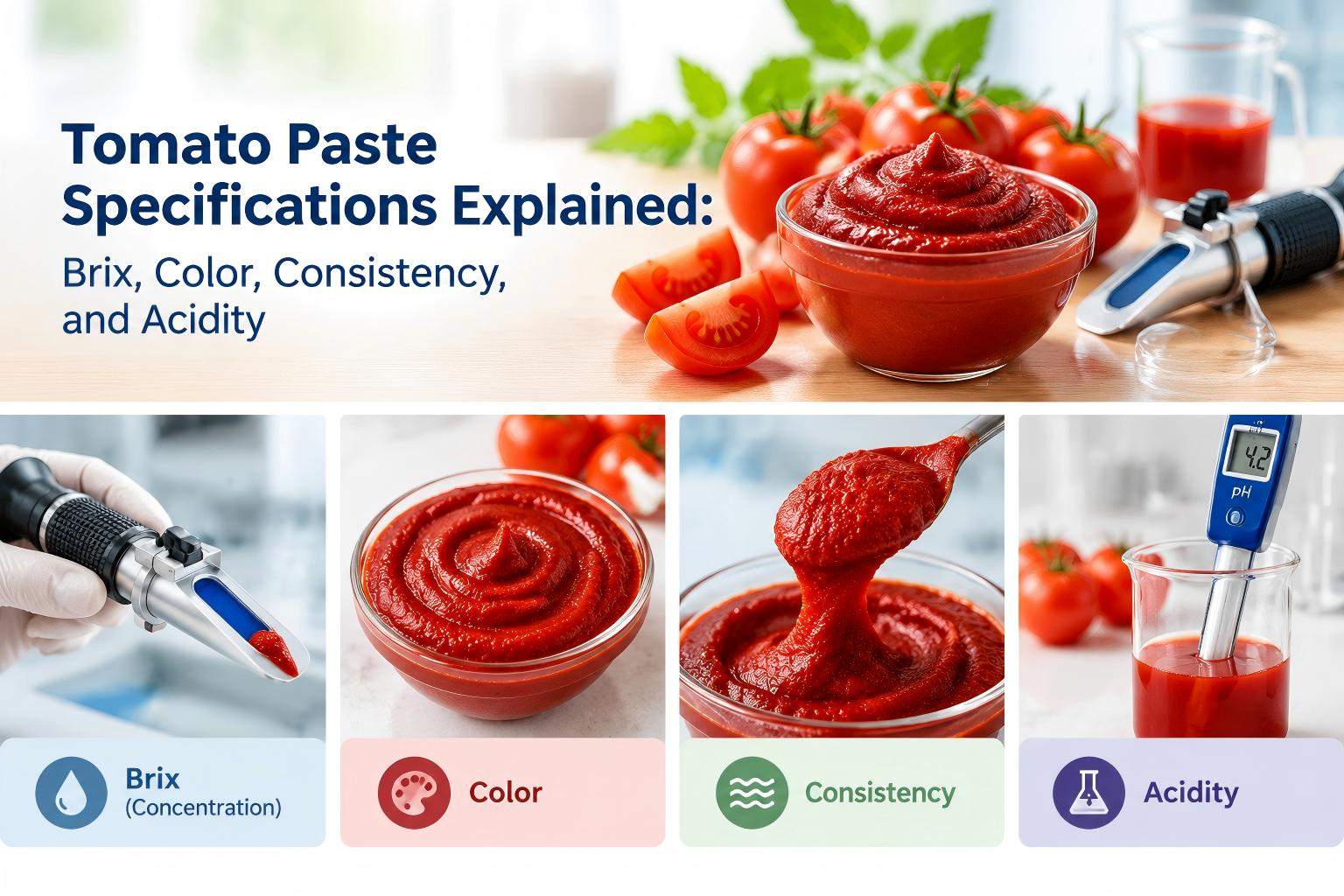
Brix is one of the first specifications buyers check when purchasing tomato paste in bulk. It indicates the concentration of soluble solids in the product, including sugars, organic acids, and other dissolved substances. For tomato paste, Brix is widely used as a practical indicator of concentration.
Commercial tomato paste commonly comes in several concentration ranges, depending on the processing method and intended application.
28–30% Brix: A common specification for standard concentrated tomato paste used in sauces, cooking, and food processing.
36–38% Brix: A higher-concentration option suitable for applications requiring more tomato solids in a smaller quantity of product.
These ranges are common commercial specifications rather than universal requirements. Actual specifications should be confirmed with the supplier and agreed upon in the purchase contract.
Brix affects how much tomato paste is required to achieve a target concentration in a finished product. Higher-Brix paste generally delivers more soluble solids per unit of product, which can help reduce the amount of paste needed in certain formulations.
For importers, however, a higher Brix value does not automatically mean a better purchase. The best option depends on the final application, target flavor, processing conditions, and total cost.
When comparing quotations, buyers should check whether prices are quoted on an as-supplied basis or normalized to a comparable tomato-solids basis. This helps avoid misleading comparisons between products with different concentrations.
Brix is commonly measured using a refractometer. In commercial production, the testing procedure should specify sample preparation, measurement temperature, and the applicable method.
Because refractometer readings can be affected by temperature and the composition of the sample, buyers should confirm that the supplier's testing method is consistent with the agreed specification.
Color is another important indicator when assessing tomato paste. Buyers typically look for a natural, uniform red appearance that matches the requirements of their target market and finished product.
Tomato paste color is influenced by several factors, including tomato variety, ripeness, growing conditions, processing temperature, oxygen exposure, and storage conditions.
Tomato variety and ripeness: Fully ripe tomatoes with suitable pigment development generally provide a stronger red color than insufficiently ripe raw materials.
Processing conditions: Excessive heat exposure or prolonged processing can contribute to color changes. Appropriate processing controls help preserve the natural appearance of tomato paste.
Storage and packaging: Exposure to oxygen, unsuitable storage temperatures, and inadequate packaging protection may affect color stability during distribution and storage.
Color may be assessed visually under standardized lighting or measured instrumentally using a colorimeter. Some buyers use the Hunter Lab color system, including the a/b ratio, as part of their quality evaluation.
The a/b ratio compares the red-green and yellow-blue color dimensions represented by the relevant instrument readings. It can help buyers compare samples, but it should not be treated as a complete quality assessment on its own.
For B2B procurement, the most practical approach is to establish an approved reference sample and define acceptable color requirements in the product specification. This is particularly useful for private-label brands and manufacturers that need consistent appearance across production batches.
Consistency describes the thickness and flow behavior of tomato paste. It influences how easily the product can be pumped, mixed, filled, diluted, or incorporated into a finished food product.
Two tomato pastes with the same Brix value may still have noticeably different textures. This is because consistency is also affected by the tomato variety, pulp structure, insoluble solids, processing method, and particle characteristics.
The processing method is an important consideration when selecting tomato paste for a particular application.
Hot Break (HB) tomato paste is produced using rapid heating to inactivate enzymes responsible for breaking down pectin. This generally helps preserve viscosity and produces a thicker paste, making it useful for applications such as ketchup, thick sauces, and products that require body.
Cold Break (CB) tomato paste is processed at lower temperatures during the initial breakdown stage, allowing more enzyme activity before inactivation. It generally produces a lighter-bodied paste with a fresher tomato flavor profile, making it suitable for selected sauces, soups, and food formulations where these characteristics are preferred.
These are general processing tendencies. The actual viscosity, color, flavor, and performance depend on the raw material and the complete manufacturing process.
Tomato paste consistency may be evaluated using methods such as:
Bostwick consistometer: Measures how far a sample flows over a specified period under controlled conditions.
Viscosity measurement: Uses an appropriate instrument and test procedure to assess resistance to flow.
Application testing: Evaluates how the paste performs during pumping, mixing, heating, filling, or dilution.
A meaningful consistency specification should identify the testing method and conditions. Temperature, sample preparation, test duration, and instrument settings can all influence the results.
For industrial buyers, choosing a paste based on Brix alone may not be sufficient. A product with the correct concentration but unsuitable flow characteristics can create processing difficulties or produce a finished sauce with the wrong texture.
Acidity affects tomato paste flavor and plays a role in the formulation and processing of finished foods. Buyers should distinguish between pH and titratable acidity, as they measure different properties.
pH measures the hydrogen ion activity of a product and indicates how acidic it is on a logarithmic scale. A lower pH indicates greater acidity in terms of hydrogen ion activity.
Tomato paste pH is influenced by tomato variety, growing conditions, maturity, and processing. It is commonly monitored as part of quality control, particularly when the paste will be used in further food processing.
Titratable acidity measures the amount of acid that can be neutralized under a defined testing procedure. It is often expressed as a percentage of a specified reference acid, such as citric acid.
While pH reflects the intensity of acidity, titratable acidity provides additional information about the product's total neutralizable acid content. The two measurements are related but are not interchangeable.
Acidity can influence the balance between sweetness and sourness, the flavor profile of the finished product, and formulation requirements. It is especially relevant when tomato paste is used in ketchup, pasta sauce, prepared meals, canned foods, and other manufactured products.
For food safety, pH should be assessed alongside the product's validated processing conditions and intended use. A pH result alone does not establish that a product is microbiologically safe or commercially shelf-stable.
Buyers should agree on appropriate pH and, where needed, titratable acidity limits with their supplier and technical team rather than relying on a single universal target.
A complete specification sheet helps buyers compare products more accurately and reduces the risk of misunderstandings during procurement.
Before confirming an order, consider the following checklist:
| Specification | What to Check | Why It Matters |
|---|---|---|
| Brix | Target concentration and test method | Determines concentration and supports cost comparisons |
| Color | Reference sample, color limits, or instrument method | Helps maintain consistent product appearance |
| Consistency | Viscosity or Bostwick requirements and test conditions | Supports processing and finished-product texture |
| Acidity | pH and, where relevant, titratable acidity | Supports flavor consistency and formulation control |
| Ingredients | Tomato content and any permitted additions | Confirms suitability for the intended formulation |
| Microbiological quality | Agreed limits and testing requirements | Supports food safety and buyer compliance |
| Packaging | Sachets, tinplate cans, plastic bottles or jugs, or bulk drums | Matches distribution, production, and storage needs |
| Shelf life | Validated shelf life and storage conditions | Supports inventory planning and market distribution |
Not every buyer needs the same level of detail. A retail brand may prioritize color, flavor, packaging appearance, and batch consistency, while a food manufacturer may place greater emphasis on concentration, viscosity, microbiological requirements, and performance during processing.
The most effective specification is one that reflects the product's actual intended use and can be verified through an agreed testing procedure.
Different applications require different combinations of concentration, color, and consistency.
Food manufacturing: Buyers should evaluate Brix, consistency, acidity, and performance during the intended production process. Consistent specifications can help reduce formulation adjustments between batches.
Ketchup and thick sauces: Hot Break tomato paste is often considered when higher viscosity and body are important. Color, acidity, and flavor must also match the finished product requirements.
Soups and cooking sauces: The choice between Cold Break and Hot Break depends on the required texture, tomato flavor, concentration, and formulation.
Retail and private-label products: In addition to technical specifications, buyers should assess consumer-facing color, taste, packaging format, shelf life, and label requirements.
Wholesale and foodservice distribution: Concentration, cost per usable unit, packaging durability, and ease of handling are key factors. Sachets and larger foodservice packs can serve different distribution models, while bulk drums are commonly used for industrial processing.
There is no single specification that is best for every application. The right choice is the combination that consistently meets the buyer's technical and commercial requirements.
For international buyers, selecting a tomato paste supplier involves more than comparing prices and Brix values. Reliable sourcing also requires clear specifications, repeatable quality control, suitable packaging, and responsive communication throughout the order process.
At Zasavor, we focus on tomato paste and related tomato products for international B2B markets. We work with buyers to evaluate concentration requirements, application needs, packaging preferences, and customized product specifications for wholesale, foodservice, and private-label projects.
Whether you are sourcing 28–30% Brix tomato paste for standard applications, 36–38% Brix concentrated tomato paste, or a product with specific color and consistency requirements, defining the technical details before ordering helps both parties establish clear expectations.
Our team can discuss available specifications, packaging options, sample evaluation, and OEM/ODM requirements according to your project needs.
Looking for a reliable tomato paste manufacturer for your next order? Contact Zasavor to discuss your target Brix, color, consistency, acidity, packaging, and volume requirements.
The appropriate Brix depends on the intended application. Commercial tomato paste commonly uses 28–30% Brix or 36–38% Brix specifications. Buyers should select the concentration based on their formulation, processing requirements, and cost per usable tomato solids.
Not necessarily. Higher Brix generally indicates a greater concentration of soluble solids, but overall quality also depends on color, flavor, consistency, acidity, microbiological quality, and compliance with the agreed specification.
Hot Break processing generally produces a thicker paste because it helps preserve pectin-related viscosity. Cold Break processing generally results in a lighter-bodied paste and may offer a fresher tomato flavor profile. The best choice depends on the finished product and its required texture.
No. pH measures hydrogen ion activity, while titratable acidity measures the amount of acid neutralized under a defined test. Both can be useful for quality control, but they provide different information.
Importers should request a product specification sheet covering Brix, color, consistency, acidity, ingredients, microbiological requirements, packaging, shelf life, and storage conditions. A representative sample and an agreed testing method can further support supplier evaluation.
Understanding Brix, color, consistency, and acidity gives tomato paste buyers a more reliable basis for evaluating suppliers and comparing quotations. When these specifications are clearly defined, importers and manufacturers can make better purchasing decisions, maintain more consistent finished products, and reduce avoidable quality issues.
The key is to evaluate tomato paste as a complete specification rather than relying on concentration or price alone. A well-matched product, supported by clear technical documentation and consistent quality control, is a stronger foundation for a long-term supply partnership.


 English
 Français
 Deutsch
 Italiano
 Pусский
 Español
 Português
 Melayu
 Indonesia
 العربية