Leave A Message
If you are interested in our products and want to know more details,please leave a message here,we will reply you as soon as we can.

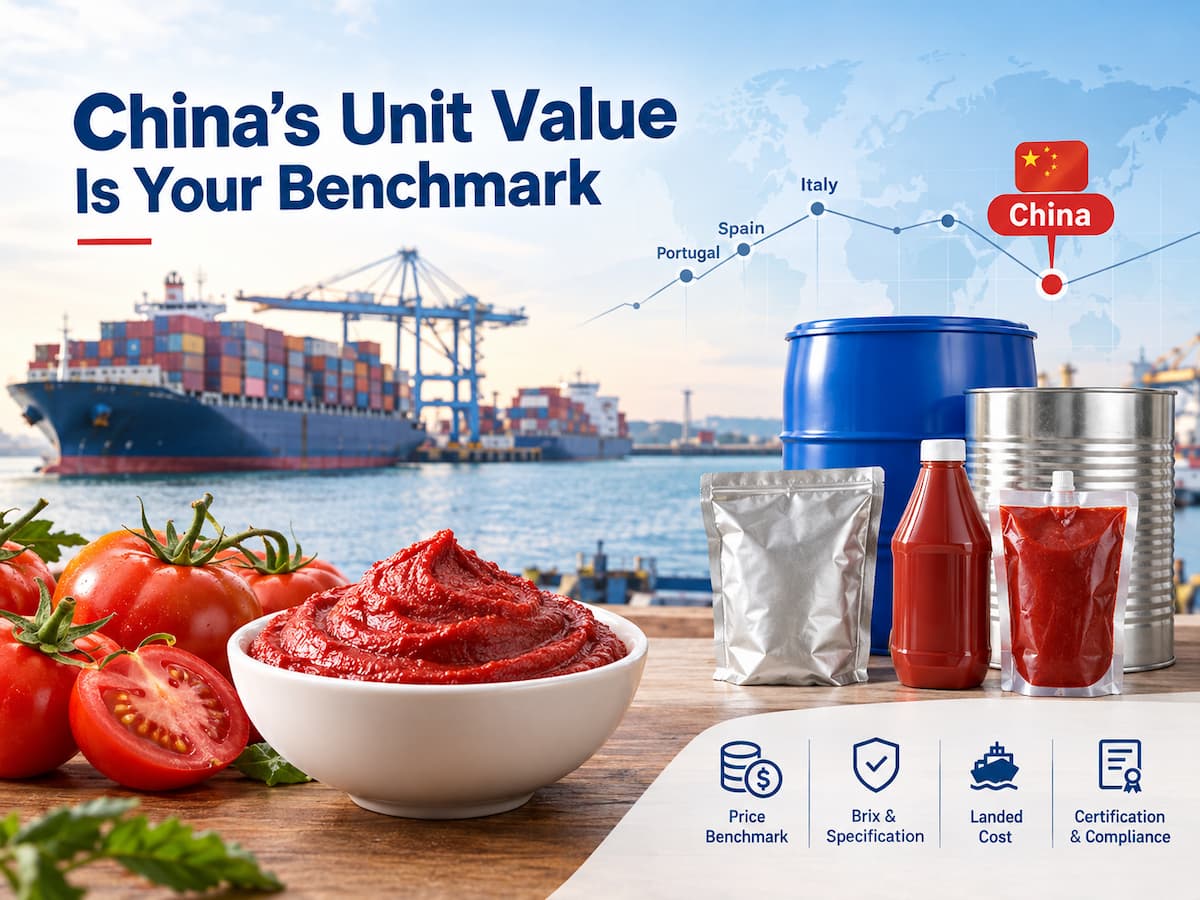
If you buy tomato paste for a retail brand, a food-processing line, or an HoReCa distributor, the single number you will keep coming back to is the China tomato paste export price per tonne. It is not the only number that matters, but it is the anchor every other quote gets measured against.
The reason is structural. China is the world's largest tomato paste exporter by volume and its unit values are published monthly — alongside the USA, Spain, Portugal, Italy and Chile — by Tomato News, which has tracked these figures since 1986. Because China ships at a scale and consistency no other origin matches, its USD/tonne value functions as the market's reference price. When an Italian or Spanish supplier quotes you a premium, the premium is almost always expressed against the China number.
For procurement teams, this means one practical habit: always re-anchor every offer to the China benchmark before negotiating. The next sections show you how to read that benchmark for August 2026 and, more importantly, what it does and does not tell you about landed cost, quality, and specification.
The August 2026 price tables published by Tomato News cover 13 complete months of average monthly unit values for each origin, broken down by 8-digit-or-more customs codes. That granularity matters: "tomato paste" (HS 200290) is not one product but a family of segments — different Brix levels, and different pack formats (drums, cans, aseptic bags) — and the unit value of each segment moves differently.
Three headline figures frame the current market:
Read those three together and the picture is clear: supply growth has slowed while demand has held firm. That is precisely the kind of environment where unit-value comparisons — China vs Italy vs Spain — start to move real negotiation leverage, because buyers who can benchmark accurately can lock pricing before any shortfall is reflected in the next monthly release.
The three Mediterranean/EU origins and China serve different segments of the same market, and their price gaps are largely structural rather than random:
The practical takeaway for a buyer is not "cheapest wins." It is that the unit value gap between China and the EU origins is your negotiation space. If a European-origin quote carries a 25–40% premium over the equivalent China value, that premium should be paying for something concrete — EU documentation, a specific Brix profile, shorter transit — rather than being accepted as ambient "market price."
A unit value in USD/tonne is an FOB-level reference. To turn it into a decision you need to add the layers that unit values deliberately exclude:
1. Normalize for Brix. Unit value per tonne is meaningless unless you compare like-for-like concentration. A double concentrated tomato paste (28–30% Brix) and a triple concentrated (36–38% Brix) carry very different per-tonne prices and very different usage economics. Always compare unit values within the same Brix band.
2. Decide hot-break vs cold-break before pricing. Hot-break paste holds viscosity and is preferred for ketchup and sauces; cold-break preserves brighter color and fresher notes for certain formulations. The process choice changes the specification you actually quote — and therefore the price.
3. Build landed cost from FOB. Add freight, insurance, duty and port charges to move from FOB price to CIF price to true landed cost. The cheapest FOB unit value can quietly become the most expensive landed product if the origin's logistics and documentation are weak.
4. Verify certifications before you commit. For most importing markets you will need at least food-grade compliance, and often Halal, HACCP or BRC — plus the export documents (certificate of origin, health certificate, commercial invoice, packing list) that clear customs without delay. This is where "China tomato paste supplier" selection stops being about the price table and starts being about reliability.
The bottom line for a procurement decision in late 2026: China's unit value remains the market's anchor, the EU origins carry a structural premium you should demand justification for, and the buyer's real job is normalizing Brix, process and certification before comparing a single number.
Q: What is the average China tomato paste export price per tonne in 2026?
A: China's export unit value is published monthly in USD/tonne by Tomato News across 13 rolling months, segmented by customs code. The headline value moves with Brix band and pack format, so there is no single fixed number — but China consistently anchors the low end of the six-origin comparison, which is why it is the reference point for wholesale tomato paste prices globally. For a current quote against your specific Brix and packaging, request it directly from a supplier with active export lines.
Q: Why is China tomato paste cheaper than Italy and Spain?
A: The gap is mostly structural. China's Xinjiang and Inner Mongolia growing regions deliver scale and a short, high-yield processing window, and its factories run large-volume continuous lines across the full Brix range. Italian and Spanish values reflect smaller average scale, EU-origin compliance costs and brand premiums. The premium is real — but it should map to a concrete benefit (EU documentation, shorter EU lead time, a specific profile), not just "market price."
Q: What Brix should I buy — double or triple concentrated?
A: It depends on your formula and freight economics. Double concentrated (28–30% Brix) is the workhorse for sauces and ketchup; triple concentrated (36–38% Brix) ships more tomato solids per tonne and can cut freight and warehousing cost for large buyers, but needs more water back at the factory. A full-range supplier can help you run the landed-cost math for your specific production.
Q: Cold break or hot break — which is right for my product?
A: Hot-break paste is heat-treated at the break stage to keep high viscosity — the standard choice for ketchup, sauces and products that need thickness. Cold-break paste keeps brighter color and fresher flavor, favored in certain formulations. Reputable exporters offer both and can advise based on your target recipe, because the wrong break process is expensive to fix after the fact.
Q: What is the minimum order quantity (MOQ) and how do I get samples?
A: MOQ varies by packaging — drums and aseptic bags typically run in full-container quantities, while smaller formats (cans, sachets, pouches) allow smaller trial orders. A supplier that genuinely wants export business will provide free samples so you can test color, viscosity and flavor against your recipe before committing to a container. Always verify samples against the exact specification you will order at scale.
Q: What certifications and export documents should I require?
A: At minimum, food-grade certification; depending on destination, also Halal, HACCP and BRC. Your supplier should handle the full document set — certificate of origin, health certificate, commercial invoice, packing list — and support customs clearance to avoid port delays. Ask for copies up front and confirm the certificates are current for the specific factory, not a group-level placeholder.
Q: How do FOB and CIF prices differ for Chinese tomato paste?
A: FOB covers the goods loaded at the port of origin; CIF adds insurance and freight to the destination port. A low FOB value can hide high freight and weak documentation, so always build the full landed cost — FOB + freight + insurance + duty — before comparing origins. A supplier that offers integrated logistics and full export documentation makes this comparison honest and fast.


 English
 Français
 Deutsch
 Italiano
 Pусский
 Español
 Português
 Melayu
 Indonesia
 العربية