Leave A Message
If you are interested in our products and want to know more details,please leave a message here,we will reply you as soon as we can.
European tomato paste supply is tightening. Looking for reliable tomato paste supply? Read our expert analysis below or contact our export desk directly. Talk to Our Export Desk →
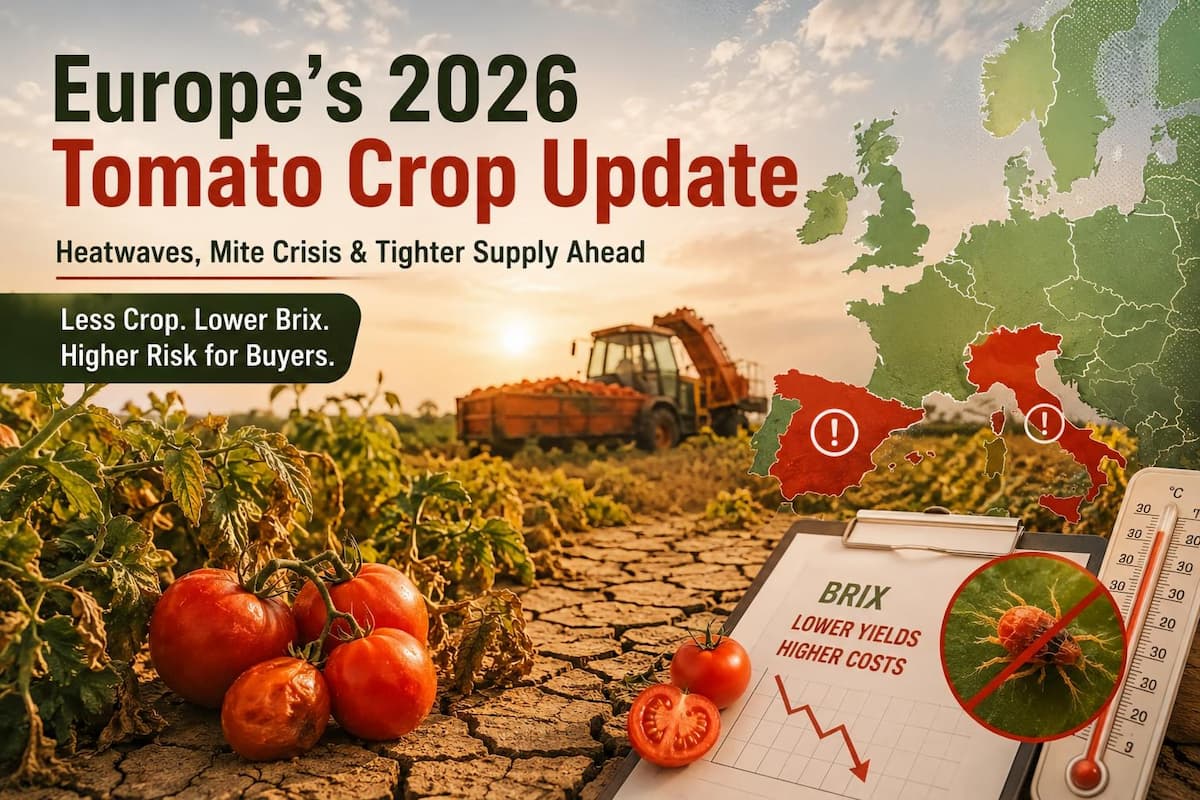
The WPTC crop update as of 28 August 2026 tells a story that importers rarely hear at the start of a season: the European processing tomato crop is shrinking in the middle of the harvest. The world production estimate now stands at 39.8 million tonnes — 1.5% below the 40.3 million tonnes processed in 2025 — and that number is still provisional because China's crop data has not yet been updated.
Behind that headline figure are three converging pressures:
France has reduced its expected total to 145,000–150,000 tonnes, with only 55% processed by the end of week 34. Bulgaria reports yields roughly 10% below normal with unusually low colour. Even Egypt — outside the core European bloc — has planted 5–7% less acreage as growers shifted to other crops over rising fertilizer, pest-control, and energy costs.
For a buyer, the practical meaning is simple: less European tomato paste will be available on the spot market next spring, and contracted volumes will be allocated earlier.
The sharpest single shock this season is in Spain, and it is not a weather story — it is a policy story with agronomic consequences.
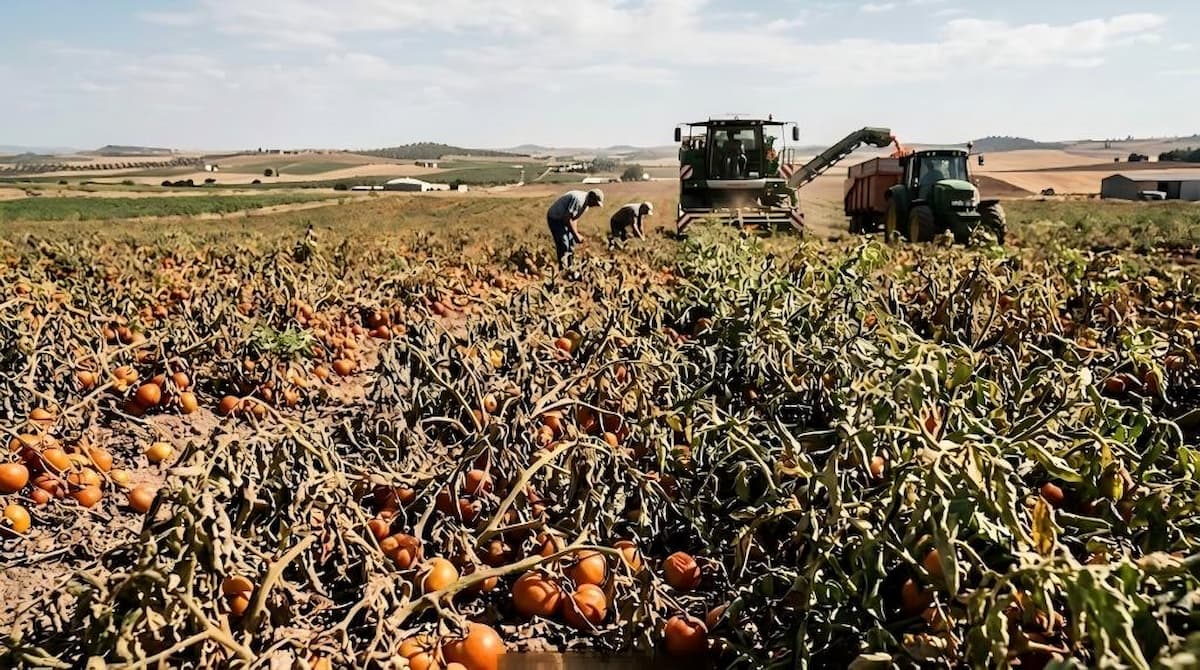
Extremadura generates nearly three-quarters of Spain's processing tomato crop. This year, high temperatures and low humidity have fuelled a massive outbreak of the tomato russet mite, locally known as Vasates. The microscopic pest sucks plant cells and dries out vines prematurely. An estimated 20,700 planted hectares have been affected, with projected yield losses of up to 30%.
What turned a difficult season into a crisis was a regulatory change. Growers previously relied on Movento (spirotetramat) as a single-application safeguard — a treatment costing roughly €70–80 per hectare. Its sudden prohibition left no equivalent replacement. According to industry agronomists, growers are now forced to apply at least three authorised alternatives costing €100–170 per hectare, with worse results. The ban has also "favoured the resurgence of pests that had previously been well controlled," including green aphids and whitefly.
In severely infested fields, plants dried out before reaching maturity, forcing growers to harvest 10–15 days earlier than the natural cycle. Mid-season and late crops suffered most, exactly when peak pest pressure collided with summer heat.
The lesson for procurement teams: origin concentration is a real supply risk. When a single region and a single active ingredient carry most of a category's output, one regulatory decision can move global availability.
When buyers talk about "the crop," they are really talking about two numbers: tonnage and Brix.
Brix measures the soluble solids in tomato paste — effectively its concentration. A heat-stressed crop delivers lower Brix because the plant diverts energy into survival rather than sugar accumulation. That matters commercially: processors must evaporate more water to reach a target concentration, which lowers yield per tonne of raw tomato and pushes cost per tonne of finished tomato paste upward.
This season, the pattern is unusually visible:
For comparison, standard commercial tomato paste Brix specifications run from 18–20% (single-strength concentrate) up to 36–38% (triple concentrate), with 28–30% cold- or hot-break paste the workhorse of the global ingredients trade. Lower field Brix means the mid-range specs — the ones most importers buy — are where availability pressure concentrates first.
Italy's picture is more mixed, which is itself worth understanding.
The 14 August WPTC update revised Italy upward to 6.35 million tonnes — the one notable bright spot in the AMITOM region. But the same update warns that widespread heatwaves are "accelerating ripening and increasing pest pressures (mites, diseases), threatening yield reductions for late-season crops." In the North, harvest began very early — 9 July for certain specialty varieties — which compresses the window and raises the risk of processing bottlenecks.
The strategic reality for importers:
This is precisely the environment in which sourcing diversification moves from "best practice" to "necessity." Many importers who have historically split volumes between Italy and Spain are now asking the same question: who can step in with contracted volume, consistent Brix, and food-grade certification?
When supply tightens, the cost of choosing the wrong supplier rises. Based on how experienced buyers evaluate origins in a short crop year, here is what to verify before you commit:
Publish this section with FAQPage schema markup. A compact JSON-LD example covering the first three Q&As is shown below the list; extend it in the same pattern for the rest.
Why is European tomato paste supply tight in 2026?
Successive heatwaves, sunburn, and localized storms have cut yields and Brix across Southern and Western Europe. WPTC has reduced forecasts for France, Spain, and Türkiye, and world production is estimated 1.5% below 2025 at 39.8 million tonnes — before China's update is included.
What happened to Spain's tomato crop this year?
Spain's Extremadura region, which produces about three-quarters of the national crop, suffered a severe outbreak of the tomato russet mite (Vasates) affecting around 20,700 hectares, with yield losses of up to 30%. The ban on the insecticide Movento (spirotetramat) removed growers' primary control tool, worsening the damage.
What's the difference between cold-break and hot-break tomato paste?
Cold-break heats tomatoes gently (roughly 60–70°C) to preserve bright red colour and fresh flavour; hot-break heats quickly to higher temperatures (around 85–95°C) to deactivate enzymes and produce a thicker, more viscous paste. Choose cold-break for colour-sensitive applications and hot-break for sauces and recipes where body matters.
Which Brix concentration should I buy?
It depends on your end use. 22–24% suits direct foodservice use; 24–26% is a common industrial standard; 28–30% is the workhorse for re-manufacturing into sauces and ketchup; 36–38% triple concentrate minimises shipping cost per dry-tonne. Reputable suppliers offer the full 18–30% range and can hold your exact spec.
Is Chinese tomato paste certified for my market?
Leading export manufacturers hold HACCP, ISO, Halal, and BRC certifications and can provide documentation for customs clearance. If you supply the Middle East, Africa, or EU retail, ask for the specific certificate your buyer requires before ordering.
What is the minimum order quantity, and can I get samples?
MOQs vary by packaging and spec but are typically structured around a full container for drum and aseptic formats and smaller runs for private-label retail packs. Serious suppliers offer free samples so you can verify colour, Brix, viscosity, and taste before committing.
How do I verify quality before placing a large order? Request a free sample against your target specification, review certificates (HACCP/Halal/BRC), confirm the Brix and process (cold- or hot-break), and ask for a documented raw-material origin. For OEM/ODM projects, confirm flavour-customization accuracy and run a small pilot batch first.
Zasavor is a specialized tomato product export brand under the Fortune Global 500 company Conch Group, offering one-stop OEM/ODM export solutions for tomato paste, tomato sauce, and ketchup.
Why buyers work with us:
Packaging: flat and spout sachets, tin cans, aseptic bag-in-drum, squeeze bottles, and foodservice bulk formats.
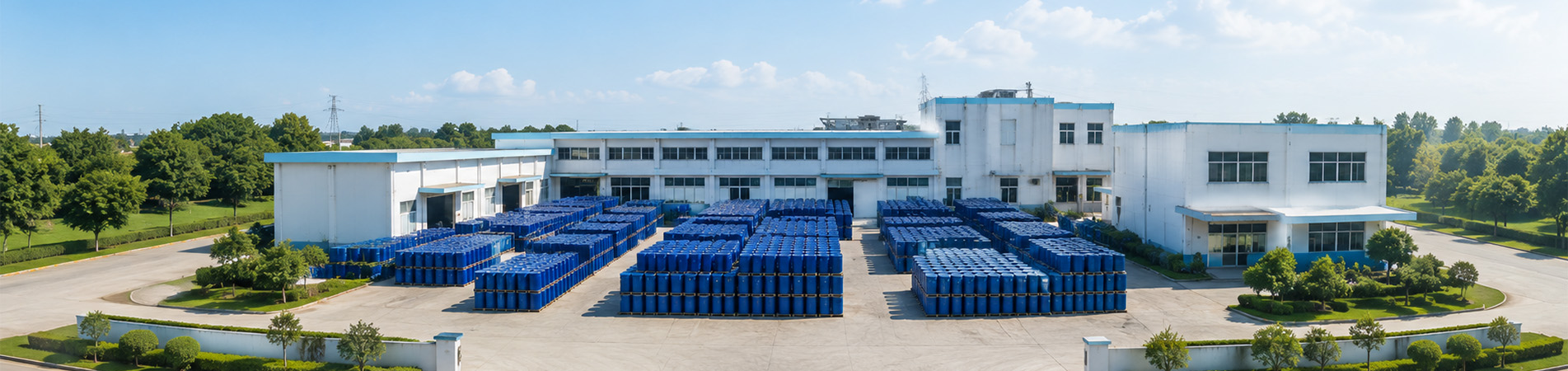
Supply chain & logistics: Our plant is located in the Chizhou Economic & Technological Development Zone, Anhui (60 mu total area, 28,000 square meters planned building area). We provide domestic short-haul warehousing, international multimodal freight (sea FCL/LCL, rail, road), and complete export documentation and customs support.
Request a Free Sample → Get a Quote →


 English
 Français
 Deutsch
 Italiano
 Pусский
 Español
 Português
 Melayu
 Indonesia
 العربية