
Leave A Message
If you are interested in our products and want to know more details,please leave a message here,we will reply you as soon as we can.

How Is Tomato Paste Made? A Step-by-Step Manufacturing Guide
When you open a pouch or can of rich, vibrant tomato paste to elevate your pasta sauces, stews, or soups, have you ever wondered about the industrial precision required to get it from the field to your kitchen?
Commercial tomato paste production isn't just about mashing tomatoes; it is a highly controlled, scientific process designed to preserve flavor, ensure food safety, and maximize shelf life.
In this comprehensive manufacturing guide, we break down the step-by-step industrial Tomato Paste Processing Flow, highlighting the critical quality control points (CCPs) that guarantee market-ready excellence.
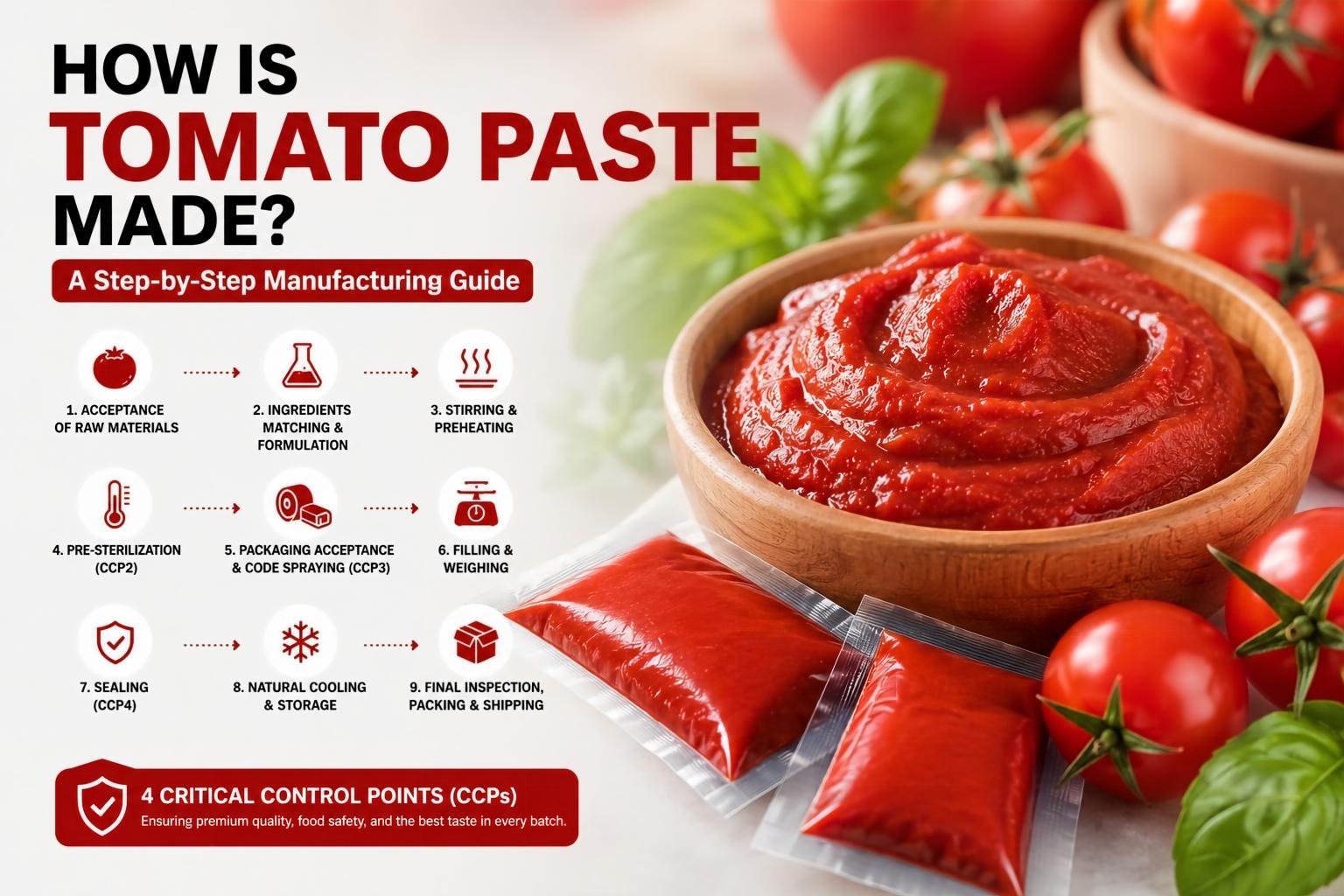
Step 1: Acceptance of Raw Materials (CCP1)
The journey begins at the factory gate. Raw materials (bulk tomato paste or fresh tomatoes depending on the line) undergo rigorous inspection upon arrival.
Critical Control Point 1 (CCP1): This initial stage is a critical control point where quality assurance teams test for acidity, Brix levels (sugar content), color, and the absence of contaminants or heavy metals. Only raw materials meeting strict regulatory and internal standards are accepted into the production line.
Step 2: Ingredients Matching & Formulation
Once approved, the raw tomato base moves to the preparation area. Here, Ingredients Matching takes place. Based on the specific recipe or client requirements (such as adjusting salt content, acidity regulators, or specific brix concentrations), precise measurements of ingredients are calculated and prepared for blending.
Step 3: Stirring & Preheating
To ensure a completely homogeneous mixture, the batch undergoes intensive Stirring. Simultaneously, the mixture is subjected to Preheating. Preheating serves two crucial functions: it deactivates natural enzymes that would otherwise break down pectin (destroying the paste’s thick texture), and it reduces viscosity to prepare the product for seamless sterilization.
Step 4: Pre-Sterilization (CCP2)
Before the paste enters any packaging material, it must be stripped of potential microbiological hazards.
Critical Control Point 2 (CCP2): The tomato paste passes through a Pre-Sterilization system (typically a tubular or scraped-surface heat exchanger). The product is held at a high temperature for a precise duration to eliminate pathogenic bacteria and spores while maintaining the paste's deep red color and nutrient profile.
Step 5: Packaging Acceptance & Code Spraying (CCP3)
While the paste is being prepared, a parallel line handles the packaging materials.
Critical Control Point 3 (CCP3): The Acceptance of Film & Empty Sachets ensures all packaging is completely sterile, defect-free, and capable of forming an airtight seal.
Once cleared, the packaging moves to the Spray Code station, where batch numbers, manufacturing dates, and expiration dates are clearly printed onto the film or sachets.
Step 6: Filling & Weighing
The paths converge at the filling station. In a strictly hygienic environment, automated machinery executes Filling and Weighing. The sterilized tomato paste is injected into the prepared sachets or pouches at precise weights to ensure consistency and eliminate product giveaway.
Step 7: Sealing (CCP4)
Critical Control Point 4 (CCP4): Immediately after filling, the packaging undergoes Sealing. This is the final and incredibly vital Critical Control Point. An airtight, hermetic seal is mandatory to prevent any post-process recontamination, ensuring the product remains commercially sterile throughout its entire shelf life.
Step 8: Natural Cooling & Storage
Because the paste is filled at high temperatures, the sealed packages move to a Natural Cooling area. Allowing the product to cool gradually prevents thermal degradation of the packaging material and protects the paste's quality. Once cooled, the batches are moved to temporary Storage warehouses for quality hold clearance.
Step 9: Final Inspection, Packing, Shipping & Carton Acceptance
Before leaving the facility, the finished goods face a final hurdle:
Inspecting, Packing, and Shipping: Quality control teams pull samples for final physical and microbiological testing. Once cleared, sachets are automatically packed into shipping boxes.
Acceptance of the Carton: The outer corrugated cartons are inspected for durability and proper labeling to guarantee they can withstand the rigors of global transit and logistics.
Why Choose Our Tomato Paste Solutions?
Understanding the meticulous process behind tomato paste manufacturing highlights the importance of choosing a supplier committed to safety and consistency. By tracking four separate Critical Control Points (CCPs), our processing methodology ensures every batch delivers premium texture, rich flavor, and uncompromising food safety.
Are you looking for a reliable, bulk tomato paste supplier or private label partner? Contact our team today for specifications, quotes, or to learn more about our certified manufacturing capabilities!


 English
 Français
 Deutsch
 Italiano
 Pусский
 Español
 Português
 Melayu
 Indonesia
 العربية