
Leave A Message
If you are interested in our products and want to know more details,please leave a message here,we will reply you as soon as we can.

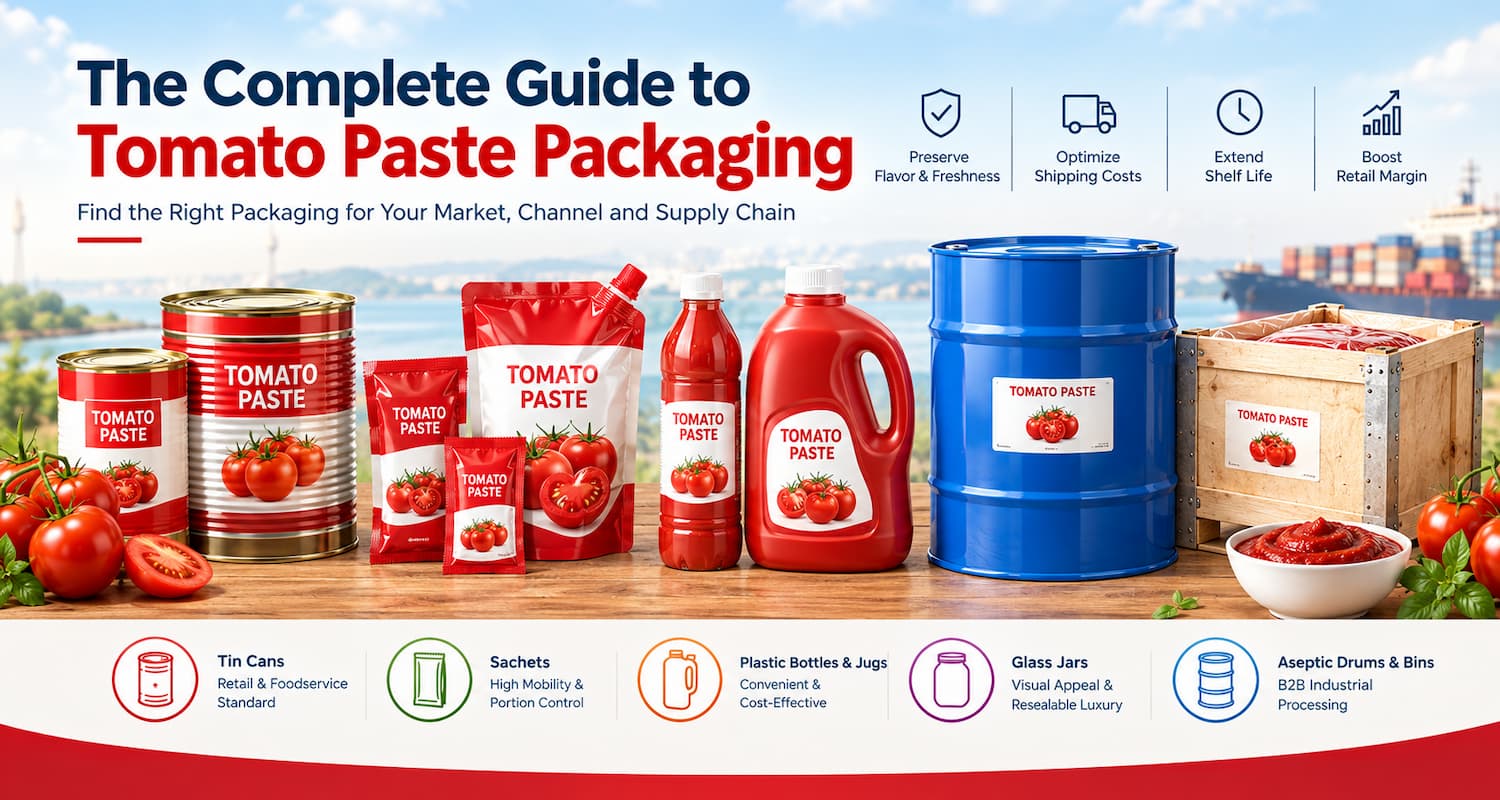
Selecting the ideal tomato paste packaging is one of the most strategic decisions for foreign trade importers, distributors, and food brand owners. Beyond preserving rich flavor and vibrant color, your choice of packaging directly impacts container freight costs, shelf-life integrity, retail profit margins, and ultimate consumer adoption.
Whether you are catering to high-volume retail chains, traditional open-air markets, or industrial food processors, here is a practical B2B guide to choosing the right tomato paste packaging format for your target market.
Metal tin cans remain the most widely accepted packaging format across global markets—particularly in West Africa, the Middle East, Central Asia, and Latin America.
Key Advantages: Superior barrier protection against light and oxygen, robust stacking strength during long-distance shipping, and an extended shelf life of 24 to 36 months without refrigeration.
Inner Coating: High-grade food-safe lacquer (lacquered interior) to prevent corrosion and acidity reaction.
Common Specifications:
Retail Portions: 70g, 210g, 400g, and 800g (Available in both Easy-Open Lids and Hard-Open Lids).
Foodservice & Institutional: 2.2kg, 3kg, and 4.5kg catering tins.
Market Fit: High-volume wholesale channels, traditional grocery retail, commercial kitchens, and regions with demanding ambient storage temperatures.
Procurement Tip: If you are supplying high-rotation wholesale markets, sourcing directly from reliable bulk tin canned tomato paste suppliers ensures consistent double-sealing quality and competitive container loading quantities.
Flexible film packaging has experienced massive growth across price-sensitive markets and fast-moving urban retail centers due to its low unit weight and affordability.
Key Formats & Sizes:
Flat Sachets (50g–70g): Ideal for single-meal portion control, preventing food waste in households without refrigeration.
Stand-Up Spout Pouches (250g–1000g): Recloseable, modern, and lightweight alternatives to rigid containers.
Key Advantages: Drastically reduces total shipping weight and box volume, lowering sea freight costs per metric ton. High-barrier aluminum foil laminates effectively shield the product from tropical heat and humidity.
Market Fit: Developing retail markets (such as Sub-Saharan Africa and Southeast Asia), modern supermarkets seeking eye-catching shelf presence, and cost-conscious consumers.
Customization Strategy: Working with a factory capable of producing custom printed tomato paste sachets allows distributors to build strong local private label brand recognition with vibrant rotogravure printing.
For medium-to-large culinary operations that require more product than a standard tin but less volume than an industrial drum, rigid plastic containers offer the perfect balance.
Key Advantages: Resealable screw caps or snap-on lids, ergonomic carrying handles, non-corrosive body, and lighter tare weight compared to large metal cans.
Common Sizes: 1kg, 2.5kg, 5kg, 10kg, and 20kg.
Market Fit: Commercial restaurants, hotel catering services, bakeries, central kitchens, and regional food service distributors across the Middle East and North Africa.
Usage Insight: Plastic jugs and pails allow kitchen staff to easily measure, pour, and reseal high-concentration paste during high-speed food prep without needing specialized opening tools.
When supplying large-scale food manufacturing plants, small consumer packaging is inefficient. Processing factories require bulk raw materials delivered in sterile, high-capacity containers.
Key Advantages: Cold/Hot Break processing, sterile aseptic bag protection, zero preservatives required, and high concentration stability (typically 28–30% or 36–38% Brix).
Common Formats: 220L Aseptic Steel Drums (4 drums per pallet) and 1000L IBC Wooden/Plastic Bins.
Market Fit: Ketchup manufacturers, chili sauce processors, ready-meal factories, and regional repacking facilities.
Industrial Procurement: Sourcing 28-30 brix aseptic tomato paste in drums guarantees that re-processors receive high-viscosity, rich-lycopene raw tomato paste ready for secondary formulation and blending.
Local Consumer Cooking Habits: Do your end-users prepare large family meals daily (where 400g/800g tins dominate), or do they prefer exact single-use portions (where 70g sachets excel)?
Logistics & Import Tariffs: Heavy packaging like tin cans costs more in sea freight per unit than sachets. Calculate your landed cost per kilogram rather than just the FOB price.
Storage & Climate Conditions: In high-humidity coastal or tropical regions, ensure your tins feature premium external anti-rust varnish and your sachets utilize multi-layer PET/AL/PE foil barriers.
Choosing the right packaging format is key to dominating your local market. Whether you require OEM private label branding, bulk industrial raw materials, or comprehensive wholesale tomato paste packaging solutions, matching your product specs to local buyer preferences is the first step toward sustained sales growth.
Have questions about container loading rates, Brix selection, or shelf-life stability? Contact our trade team today for tailored quotations and product samples.


 English
 Français
 Deutsch
 Italiano
 Pусский
 Español
 Português
 Melayu
 Indonesia
 العربية