Leave A Message
If you are interested in our products and want to know more details,please leave a message here,we will reply you as soon as we can.

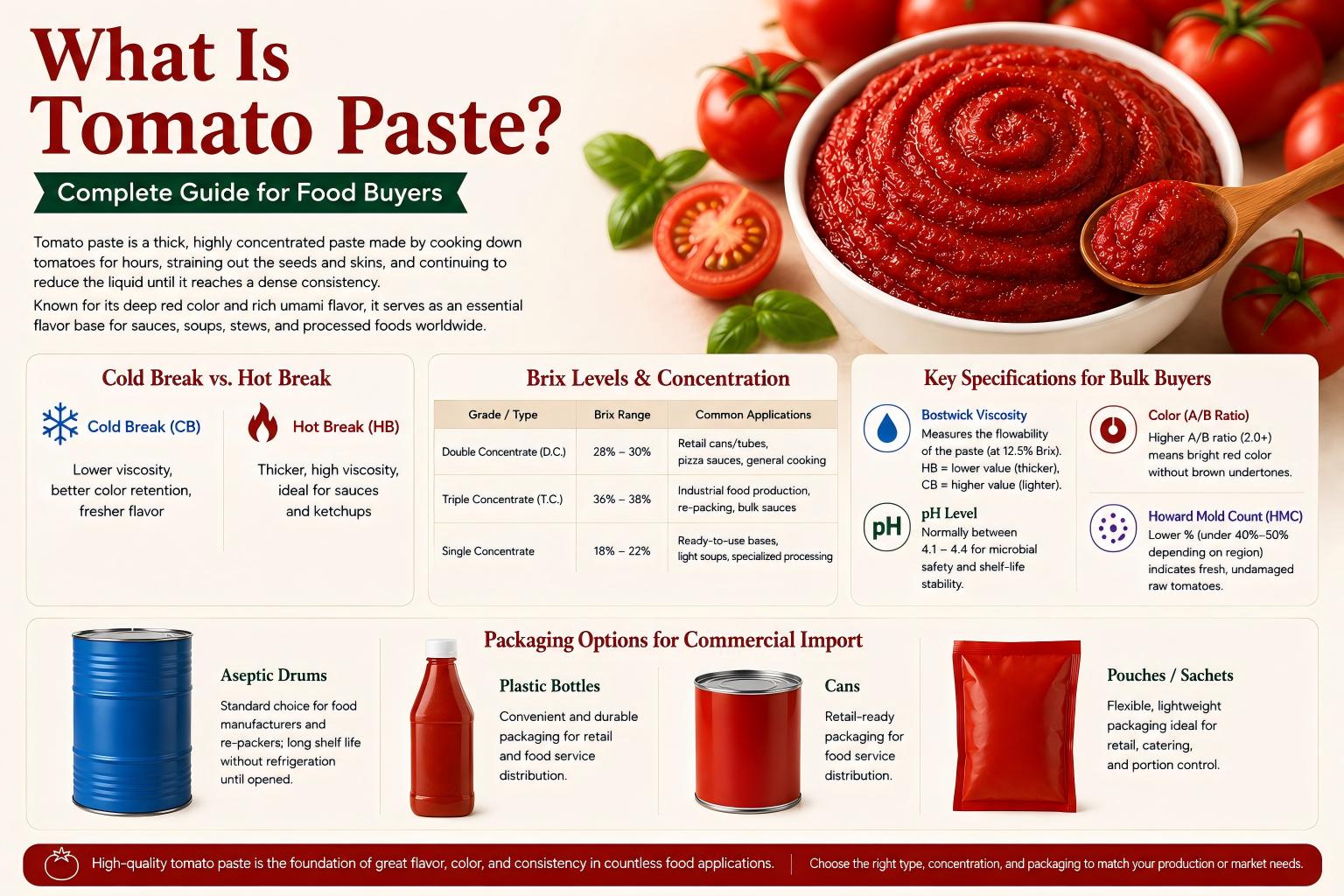
Tomato paste is a rich, dark red concentrate made by cooking down tomatoes for hours, straining out the seeds and skins, and reducing the liquid until it reaches a thick, highly concentrated consistency. For food buyers, distributors, and industrial manufacturers, securing a reliable supply of high-quality tomato paste is critical to maintaining product consistency and managing production costs.
Understanding the core technical specifications helps buyers select the exact product needed for their target applications:
Brix Levels (Concentration): Measured on the Brix scale, concentration typically ranges from 28–30% (standard double concentrated) to 36–38% (triple concentrated). Higher Brix means lower water content and greater yields per unit volume.
Break Types:
Hot Break (HB): Tomatoes are heated to higher temperatures ($>85^\circ\text{C}$) immediately after crushing, preserving natural pectins. This results in a higher viscosity, making it ideal for thick sauces, ketchup, and pizza toppings.
Cold Break (CB): Tomatoes are processed at lower temperatures ($\approx 65^\circ\text{C}$), preserving a fresher tomato flavor and brighter color, perfect for soups, juices, and lighter pasta sauces.
Choosing the right packaging format impacts shipping costs, shelf life, and ease of processing.
| Packaging Type | Target Audience & Use Case | Key Advantages |
| Sachet / Flexible Pouch | Retailers, Foodservice, End Consumers | Lightweight, portion-controlled, easy to store, cost-effective for freight. |
| Canned Tomato Paste | Supermarkets, Commercial Kitchens, HORECA | Classic format, long shelf life, robust protection against light and air. |
| Aseptic Drums | Industrial Manufacturers, Repackers | Bulk supply (typically 220L/240kg), ideal for large-scale secondary processing. |
When evaluating potential tomato paste manufacturers, prioritize these critical procurement factors:
Quality Certifications: Ensure your supplier maintains internationally recognized standard certifications, such as HACCP, ISO 22000, BRC, Halal, or Kosher, to clear customs smoothly and meet retail compliance.
Color and Lycopene Content: Look for high $a/b$ color values ($\ge 2.0$) on the Hunter Colorimeter, indicating optimal ripeness and rich natural red pigment.
Supply Chain & Shelf Life: Aseptic packaging offers a shelf life of 18–24 months when stored correctly in cool, dry conditions. Ensure your supplier provides flexible shipping arrangements for mixed container loads (FCL).
Are you sourcing tomato paste for retail distribution or industrial manufacturing? Let us know your preferred Brix level and packaging specs to receive a tailored quotation.


 English
 Français
 Deutsch
 Italiano
 Pусский
 Español
 Português
 Melayu
 Indonesia
 العربية