Leave A Message
If you are interested in our products and want to know more details,please leave a message here,we will reply you as soon as we can.

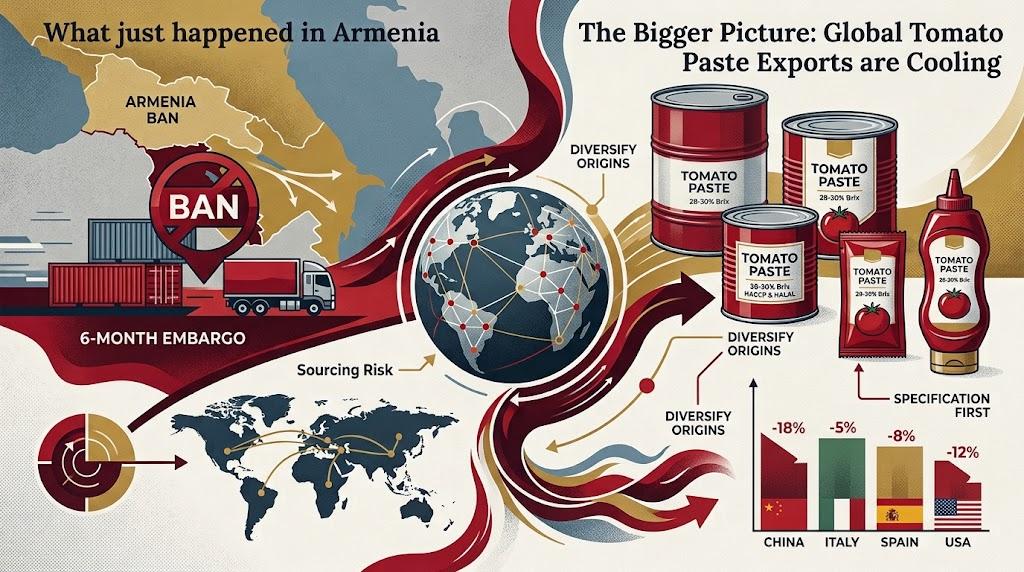
On August 3, 2026, Armenia's cabinet enacted a six-month embargo on imported tomato paste, explicitly to protect the country's domestic agricultural sector. In practical terms, foreign tomato paste is now blocked from entering the Armenian market until early February 2027.
For most global buyers, Armenia is a small destination market—but the decision matters far beyond its borders. It is part of a wider pattern: governments increasingly using import restrictions, origin-labeling scrutiny, and phytosanitary rules to shield local producers. Over the past twelve months, we've seen the same pressure surface in Australia, where country-of-origin labeling on retail tomato paste has come under national investigation.
The takeaway for importers isn't that one market closed. It's that sourcing risk is now political as much as it is logistical, and supply chains built on a single origin or a single supplier are more exposed than they were a year ago.
The embargo lands during a noticeably softer trading year. According to Tomato News' August 2026 update, global exports of tomato paste under HS code 200290 over the May 2025–April 2026 marketing year were running 1.7% below the previous period, with the 12-month total sitting just above 3.78 million metric tonnes.
The ten largest exporting countries—led by China, Italy, Spain, the United States, Portugal, Chile, Turkey, Greece, Iran, and Austria—accounted for roughly 92% of total trade. Their combined annual exports fell to just over 3.5 million tonnes, down about 62,000 tonnes year on year.
This matters to buyers for one reason above all: when the market slows and demand shifts, price and availability stop moving in lockstep across origins. A ban in one region doesn't simply remove supply—it redirects demand into neighboring origins, and that movement is rarely instant or smooth.
Tomato News' August 2026 price survey covered six key origins: Spain, Portugal, Italy, China, Chile, and the United States. For buyers, the useful way to read this is not "who is cheapest" but "how exposed is each origin to the current disruption."
China remains the structural anchor of the global trade, with Xinjiang and Inner Mongolia providing the bulk of processing-grade raw material.
Southern European origins (Spain, Portugal, Italy) are under cost pressure from a record European heatwave and an intensifying El Niño, which tightens fresh-tomato supply at the field level.
The United States (California) is grappling with long-term structural issues—ground compaction and aquifer damage in the Sacramento Valley—that constrain processing capacity over time.
For a buyer, this spread means the smart move in a disrupted year is diversification across at least two origins, not a race to the lowest per-tonne quote.
Three concrete implications follow from the Armenia decision and the data behind it:
If you're an importer, distributor, or food manufacturer looking to de-risk your tomato paste sourcing in 2026, work through this in order:
Confirm specification before origin. Decide your Brix concentration (typically 18–30%, with 28–30% the workhorse for industrial buyers), cold-break vs. hot-break process, and viscosity targets first. These determine which suppliers can even quote.
Verify certifications up front. Halal, HACCP, BRC, and FDA compliance matter differently by destination. Ask for certificates before sampling, not after a trial run.
Match packaging to the route. Aseptic drums and bag-in-box for industrial/repack, tins and sachets for retail, and bulk pails for HoReCa each carry different freight and shelf-life profiles.
Test with a sample before committing volume. Any credible supplier will ship samples for your lab to validate Brix, color (Hunter a/b), and Bostwick consistency.
Line up a second origin. Even a 10–15% allocation to a secondary supplier meaningfully cuts your exposure to a single-country disruption.


 English
 Français
 Deutsch
 Italiano
 Pусский
 Español
 Português
 Melayu
 Indonesia
 العربية