
Leave A Message
If you are interested in our products and want to know more details,please leave a message here,we will reply you as soon as we can.
Cape Town Port Delays 2026: How Chinese Tomato Paste Exporters and Global Buyers Can Mitigate Shipment Risks
If you're importing tomato paste into Africa this year, you've probably already felt it — shipments that used to take 30 days now take 40. CIF quotes that used to hold for a week now shift mid-transit. Buyers in Lagos and Accra calling to ask where their containers are.
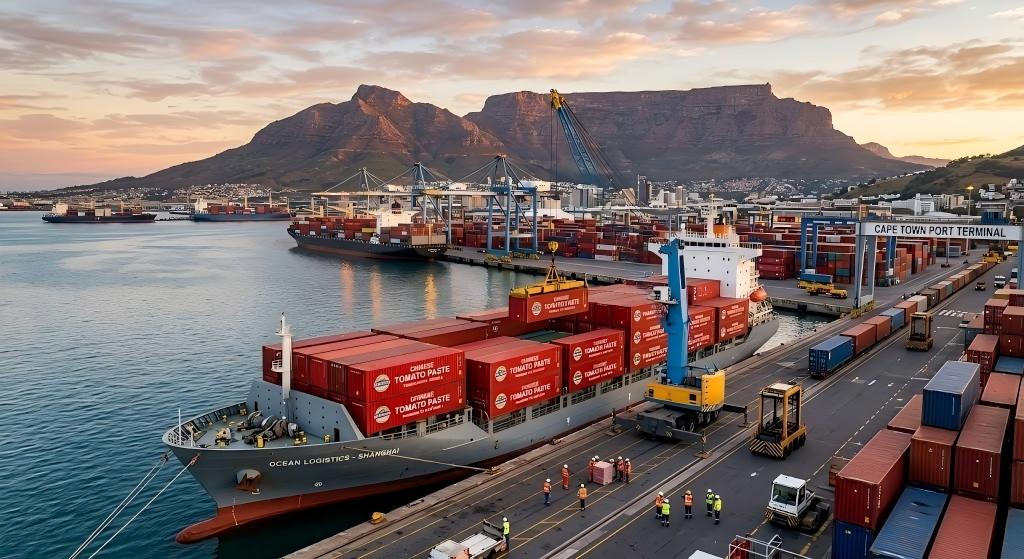
Cape Town port congestion isn't new, but the 2026 situation has escalated to a level that demands a response from every China tomato paste supplier and African buyer in the supply chain. Here's what's happening, what it costs, and how to work around it.
Three converging factors have turned Cape Town from a reliable transshipment hub into a bottleneck:
Infrastructure strain. The Cape Town Container Terminal has been operating above design capacity for several years, but 2026 brought a combination of equipment shortages — particularly ship-to-shore cranes — and maintenance backlogs that have slashed effective throughput by an estimated 15-20% compared to design specifications. Vessels that previously turned around in 48 hours now wait 4-7 days for a berth.
Weather disruptions. The 2026 Southern Hemisphere winter brought an unusually high number of days with wind speeds exceeding operational thresholds for crane operations. Each weather closure cascades through the vessel queue, pushing schedules back by days, not hours.
Volume surge on the Asia-Africa route. Chinese tomato paste export volumes to West and Southern Africa continue to grow — Nigeria alone imported over 250,000 tonnes of tomato paste in 2025, with more than 60% sourced from China. This surge, combined with general cargo growth on the Asia-Africa corridor, has increased container volumes through Cape Town beyond what the terminal can reliably process.
 |
 |
 |
For bulk tomato paste buyers and tomato paste suppliers, port delays translate into hard costs:
|
Cost Item |
Impact of 10-Day Delay |
|
Demurrage / detention |
$50-150 per container per day after free time |
|
Inventory carrying cost |
Delayed stock arrival means missed sales or emergency local purchases at premium prices |
|
Tomato paste CIF price uncertainty |
Freight rate fluctuations during extended transit make landed-cost budgeting unreliable |
|
Customer penalties |
African distributors and retailers facing stockouts may switch suppliers |
|
Working capital lock-up |
Payment terms based on shipment date mean money is tied up weeks longer |
For a mid-sized importer moving 20 containers per month, a 10-day port delay can easily add $15,000-30,000 in unforeseen costs — or about 2-4% of cargo value on wholesale tomato paste prices.
Don't put every container through Cape Town. Durban remains the largest container port in Sub-Saharan Africa and, while also busy, offers more berth availability than Cape Town for most of 2026. For West African buyers, direct sailings to Tema (Ghana), Apapa/Tin Can (Nigeria), or Cotonou (Benin) bypass the Cape Town transshipment entirely — often at a marginally higher freight rate that more than pays for itself in delay avoidance.
Experienced tomato paste for Africa exporters are now quoting CIF prices with an explicit 7-10 day transit buffer built into the delivery window. If your supplier quotes "45 days to Lagos," ask whether that includes port congestion allowance. If it doesn't, plan for 55.
Spot bookings on the Asia-Africa route are increasingly unreliable during peak season (June-October). Lock in container space 4-6 weeks ahead with a forwarder who has confirmed allocations. Monitor vessel schedules through your forwarder or platforms like MarineTraffic — if your assigned vessel gets bumped, you want to know within hours, not days.
For larger bulk tomato paste orders (100+ tonnes), shipping in flexi-tanks inside 20-foot containers can reduce per-unit freight costs and open up alternative shipping lines that may not handle standard dry containers on your preferred route. Flexi-tanks also allow direct discharge at ports without specialized container handling equipment, which can speed up turnaround at congested terminals.
The difference between a supplier who disappears when a shipment gets stuck and one who proactively manages the situation is everything. Ask potential China tomato paste suppliers these three questions before placing an order:
· "What's your backup routing if Cape Town is congested when our shipment is ready?"
· "Can you provide real-time vessel tracking during transit?"
· "How do you handle demurrage costs when delays are beyond the buyer's control?"
A supplier with established logistics partnerships and multiple carrier relationships can often reroute a shipment before it hits the bottleneck — saving weeks of delay and thousands in costs.
1. How long are the current Cape Town port delays?
As of mid-2026, vessels calling at Cape Town Container Terminal are experiencing berthing delays of 4-7 days on average, with weather-related spikes pushing some vessels to 10-14 days. Total transit time impact for Asia-to-Africa shipments transshipping through Cape Town is approximately 7-14 additional days compared to schedule.
2. Does Durban offer a better alternative for tomato paste imports?
Yes — Durban handles higher container volumes than Cape Town and has generally maintained better berth availability through 2026. For Southern African destinations, routing through Durban adds roughly 2-3 days of inland transit compared to Cape Town, but avoids the worst of the congestion. The freight rate difference is typically $200-400 per container.
3. Should I switch from CIF to FOB terms to manage port delay risk?
FOB transfers risk to the buyer at the Chinese port of departure, which can work if you have a trusted forwarder with strong Africa-corridor relationships. However, CIF keeps the logistics burden on the supplier — and experienced tomato paste exporters with volume leverage often negotiate better freight rates and faster problem resolution with carriers than individual buyers can. If you switch to FOB, make sure your forwarder has confirmed Cape Town alternatives before you commit.
4. How do port delays affect tomato paste quality?
Tomato paste shipped in aseptic bags inside drums or flexi-tanks is shelf-stable for 18-24 months when stored properly. An additional 10-14 days in transit does not compromise product quality — the risk is commercial (missed delivery windows, demurrage costs), not product integrity. That said, buyers should always verify that their supplier uses proper aseptic packaging and holds relevant certifications (HACCP, BRC, Halal) to ensure product integrity throughout extended transit.
5. What's the minimum order quantity if I want to test a new supplier with a small shipment first?
Many established China tomato paste suppliers support trial orders — often as low as one 20-foot container (approximately 20-24 tonnes of tomato paste in drums, or one flexi-tank). A trial order lets you evaluate product quality, packaging, documentation, and the supplier's logistics capability before committing to larger volumes. Reputable suppliers will also provide free samples for lab testing before you place your first order.
6. Can I get a fixed CIF price that protects me from freight rate fluctuations during port delays?
Most suppliers quote CIF prices valid for 7-14 days given current freight market volatility. For longer validity periods, some suppliers offer price-lock agreements — typically requiring a deposit or letter of intent. The key is to confirm the price validity window before you place the order, and to build a freight buffer (typically 3-5% of FOB value) into your landed-cost calculations if the shipment window extends beyond the quote validity period.
This analysis is based on industry shipping data, port authority reports, and direct logistics experience on the Asia-Africa tomato paste supply chain as of mid-2026.
This guide was prepared by the supply chain team at AHCOF NEOCHAINS FOOD TECHNOLOGY (brand name: Zasavor), the tomato products export division of Fortune Global 500 company Conch Group. We produce and export 100,000+ tonnes of tomato paste annually to 86+ countries, with deep experience on the Africa corridor including Nigeria, Ghana, South Africa, and beyond.
"We Make the Tomato Products. You Make the Brand."
Why African buyers choose Zasavor:
· Africa logistics expertise: Established routing through Durban, Cape Town, and direct West African port calls with contingency planning for port congestion
· Flexible ordering: Trial orders from 1×20'FCL supported; 18-30% Brix full range (22-24%, 24-26%, 28-30%), cold break and hot break available
· Certified quality: HACCP, Halal, BRC certified; 100% fresh Xinjiang and Inner Mongolia tomatoes, zero additives
· Packaging options: Sachets (flat/stand-up pouch), cans, aseptic drums, flexi-tanks, bulk dispensers — full OEM/ODM customization
· Free samples: Product samples shipped for your lab testing before you commit
→ Contact our Africa export desk for a tailored tomato paste supply proposal with port-delay contingency planning.


 English
 Français
 Deutsch
 Italiano
 Pусский
 Español
 Português
 Melayu
 Indonesia
 العربية